Monday, 24 November 2014

Opening to a Thriller analysis: Gone Girl

The film starts with an eerie hallowing music providing the underlying sound whilst the audience is shown a dark screen. Nick Dunne, the protagonist character begins to speak in what can be described as a mere, calm whisper saying “When I think of my wife, I always think of her head” which upon first impressions sounds as though Nick Dunne is a man devoted to loving his wife. As the audience we expect the protagonist to begin describing what he loves about her in a typical list fashion. This is revealed to not be the case as Nick Dunne slowly whispers “ I picture cracking her lovely skull”, this lets us as an audience know that the protagonist is a sick character, as he still uses a nice adjective to describe her skull, yet informs us he visions killing her brutally. This introduces the audience to the sick nature of the film, and gives us an insight about what to expect. Contradicting Nicks speech is an close up shot of his wife Amy Dunne, looking upwards, away from the camera so her eye line does not match the camera. This helps the audience infer however that she is looking admiringly at her husband, this is also supported by the fact she looks very seductive – wearing minimal clothing and showing a lot of skin.

After this shot, we are shown a series of quick images on the surrounding area, images of a window, old fashioned shots of a town looking deserted. From this we can assume that it is early morning in the town, a time when no one is about, which adds to the creepy atmosphere of the thriller. We are informed discreetly of the time, by a panning shot of a clock in the middle of the town, revealing the time to be 7am.This is followed by a shot of the main character, Nick, standing outside his house at this inferred early hour, next to his bins looking across the road which adds to the mentally unstable image we have already formed in our head of Nick.  The sound we here is the same sinister music, however the diegetic sound of Nick shutting his door is louder and takes up more of the audiences attention. Text appears on the screen saying “July 5th: The morning off” which further makes the audience question what is happening. By not finishing the sentence this makes the audience ponder and guess what is significant about that morning, and adds to the suspense that has already been created by Nicks first speech. The shots then continue off Nick getting into a Black Range Rover and pulling up. We can infer that he is at a bar as there is a shot that precedes his entrance of a sign saying “The Bar” which is already strange and is a stark contrast to places people go in the morning.  The colour scheme seen throughout is dull and includes a lot of grey tones, the outfit of the woman Nick speaks to in the bar should contrast because her top is yellow however noticeably does not.


Thursday, 20 November 2014

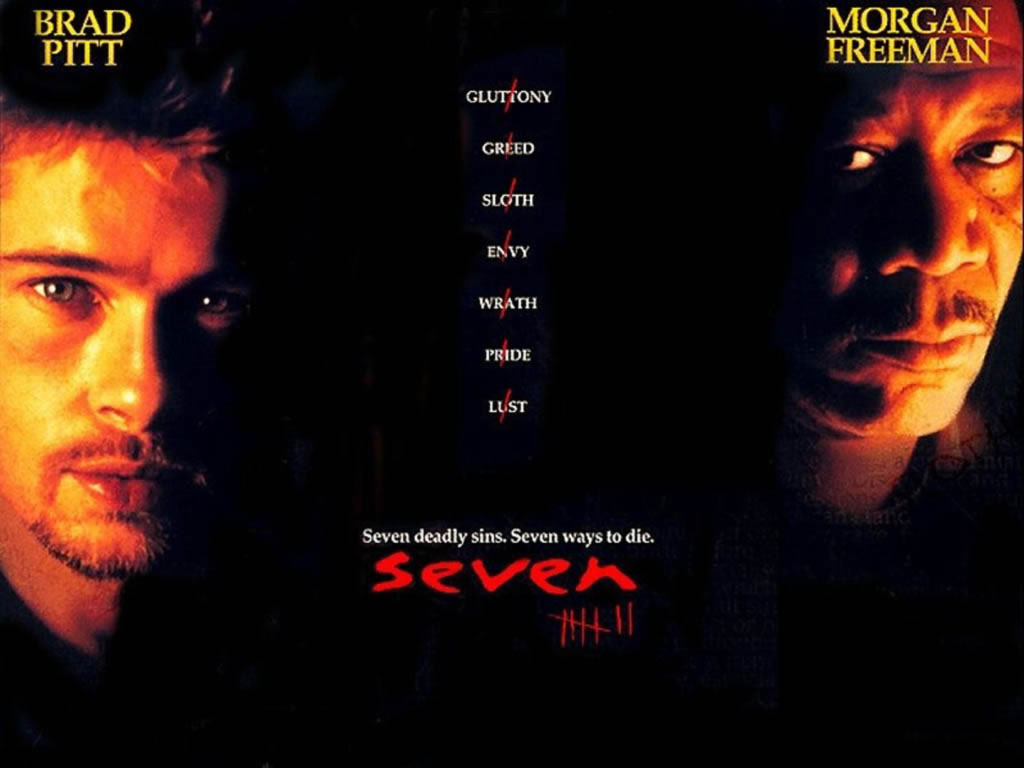
Opening to a thriller: Seven analysis

The film, Seven, is a well known thriller starring Brad Pitt and Morgan Freeman. I have written an analysis on the camera angles used in the film and how they create effect and meaning.

The film starts with a Flash Cut watching a black and white picture with the title "Se7en" printed in white appearing, the white contrasting the dark background and creating a sense of suspense. Throughout the whole opening sequence there is no establishing shot, which is usually used at the beginning of a scene to indicate the location or setting. This already adds to the thriller aspect, as the audience has not been given any clues as to where the action is taking place. Another shot used is an over-the-shoulder shot, otherwise known as a point of view shot, which allows the audience to look what is happening from the protagonists point of view, as he is moving various items. The most important camera range that is taking place during the opening sequence is a arguably the older-the-shoulder close up, which gives us a detailed insight into what is being prepared.


Monday, 17 November 2014

Thriller ideas

Here I have inserted an image of our work produced in lesson regarding our media ideas for our main task.

Friday, 7 November 2014

Conventions of Thriller Films

As our new project includes creating a thriller film and recording it, for our coursework; we have been asked to research a thriller film and write down the conversions of them. First I have thought to consider what is a thriller film? what defines them?

A thriller film is a film, genuinely face paced with a lot of suspense in places, including an antagonist and protagonist character, when there is disruption in the equilibrium. The plot usually becomes tense, waiting for the climax to reach the conclusion.

After considering the basics of a thriller film, I was led to consider, what aspects make a thriller different to any other media in terms of filming?

Usually throughout thriller films generally;  the lighting will be low, with quick cuts showing tension, music representing the dark and tense mood, often diegetic sounds of breathing, montage shots showing parts of the action and finally the protagonist is in the mercy of the antagonist.

In regards to characters, I pondered about how they are often presented?

There is almost always an protagonist and an antagonist. With the protagonist wanting to restore peace and generally not doing anything specifically wrong, the antagonist will most likely have a hidden personality which is uncovered later on, seeking revenge on the protagonist throughout the thriller.

After watching a thriller as an audience, I wondered, how do thrillers make the audience feel?

The audience should be expected, after watching a thriller film, to be thoroughly convinced that the events within the film could happen to them. Feeling scared, they should be fully invested in the film and the realistic style of the plot.

After investigating thriller films, it only makes me more excited to research more and decide what I will include in my thriller film coursework.

Monday, 27 October 2014

Preliminary Piece and Evaluation

We have finished filming and editing our preliminary piece, and I have wrote an evaluation on it, I will insert both links before. I am very happy with how it has gone and look forward to starting our thriller works.


Wednesday, 8 October 2014

Case Study Homework


For my theory class in Media, my teacher, Miss Fry set us homework to complete a case study on a TV Drama of our choice. No one was allowed to do the same drama, which makes sense as in the future we will use the case studies to revise all the TV Dramas for the examination. I have chosen to do my presentation on Gossip Girl, which is a show I very love and am passionate about. I have already started my presentation, which I have concluded is because I very much enjoy Gossip Girl and therefore enjoy writing about it. Within our case study we are expected to answer questions on; how the show represents sexuality, age, gender, how the show uses camera shots and what effect these give, why the show was made, how popular the show it etc. I am excited to finish my presentation, and then print out a copy for reference. Theory very much links in with practical media, which is what I enjoy about it. As things I find out about shots and their effect will help me complete my preliminary task.
 

Friday, 3 October 2014

Premier Pro Editing

Today we had a go on the Premier Pro editing software that the school has to offer. We uploaded all of the clips that we had previously filmed and started to piece them in the right order. I learnt how to speed up a clip: by clicking on the clip, going onto Edit, then clicking Speed, and increasing the percentage from 100% to make it faster, and decreasing to make it slower. I sped up a lot of the videos of our actor walking, as it was very long and didn't get to the point. I also cut videos with the Razor tool, which was alike something I had previously used in Windows Movie Maker, so I found it very easy. Editing is very time consuming, I have definitely learnt you need a lot of patience, however as well as this I have learned practice is the key to becoming better at it, and asking friends and classmates how to do things is a good source of information